What Parents Need to Know, Ask, and Bring
Finding the right school for a child with a learning difference is more than an academic decision—it’s about finding a community where your child will be supported, challenged, and understood. With so many educational options available, it’s important to approach the search with clarity and confidence. Whether your child has dyslexia, ADHD, executive functioning challenges, or another diagnosed learning difference, here’s what you need to know to make the best choice for your family.
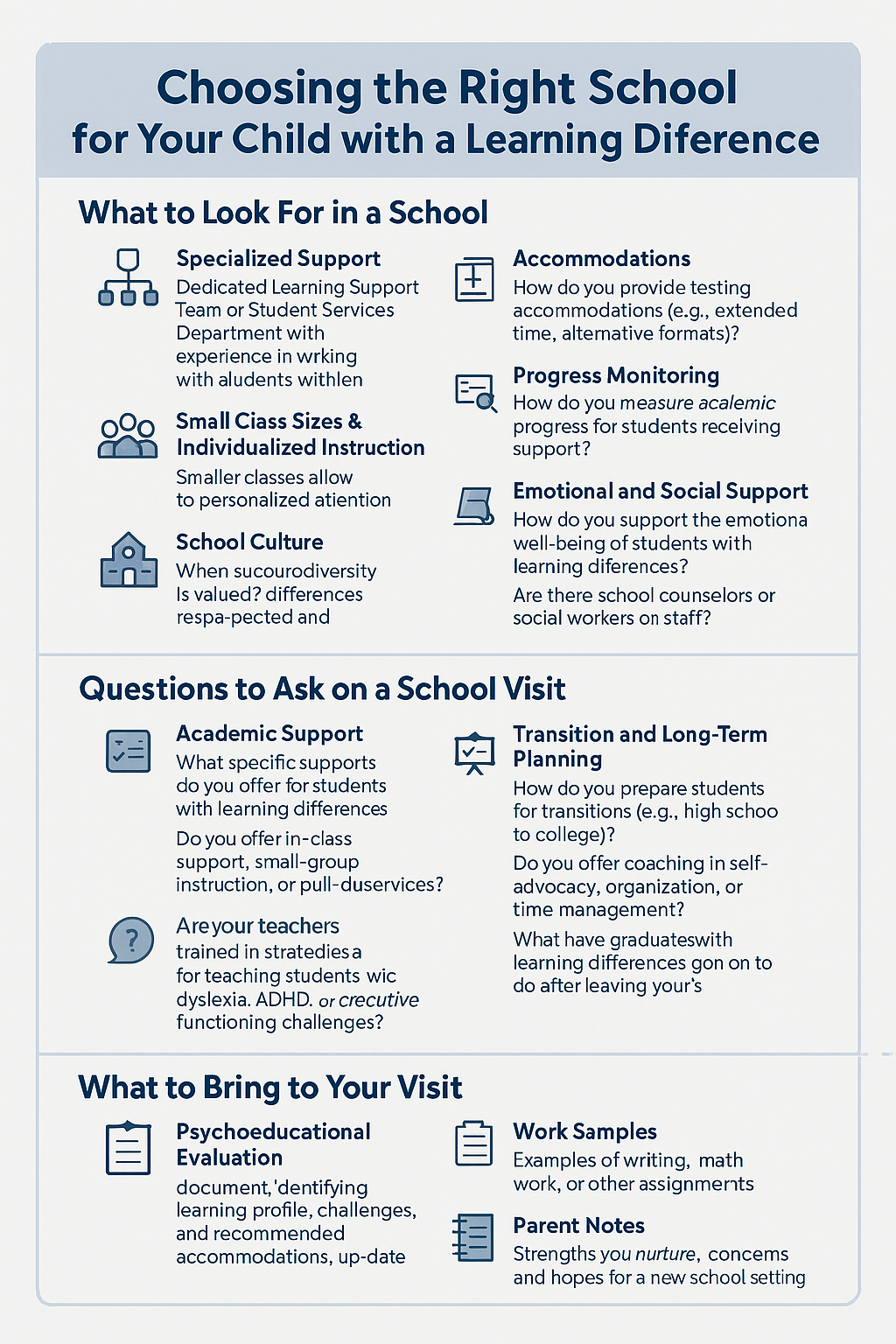
What to Look For in a School
Every child learns differently, and the right school will recognize and honor that truth. As you evaluate your options, focus on the following key indicators:
1. Specialized Support
Look for schools with a dedicated Learning Support Team or Student Services Department. These professionals should have experience working with students with learning differences and a range of tools to meet individual needs.
2. Small Class Sizes & Individualized Instruction
Smaller classes allow for more personalized attention. Ask how teachers differentiate instruction and accommodate different learning styles.
3. School Culture
Are differences respected and normalized? A strong, inclusive culture will build your child’s confidence and sense of belonging.
4. Teacher Training
Educators should be trained in evidence-based methods like Orton-Gillingham, Universal Design for Learning, or executive functioning strategies. Ask how teachers stay current on best practices.
5. Communication & Collaboration
Schools should actively partner with parents, provide regular progress updates, and be open to feedback. Look for a school that sees you as part of your child’s success team.
Questions to Ask on a School Visit
Bring these questions with you during school tours or admissions meetings to better understand how each school might support your child:
Academic Support
-
What specific supports do you offer for students with learning differences?
-
Do you offer in-class support, small-group instruction, or pull-out services?
-
Are your teachers trained in strategies for teaching students with dyslexia, ADHD, or executive functioning challenges?
Accommodations
-
How do you provide testing accommodations (e.g., extended time, alternative formats)?
-
What assistive technology is available?
-
How are accommodations implemented and monitored?
Progress Monitoring
-
How do you measure academic progress for students receiving support?
-
Will I receive regular updates on how my child is doing?
-
Is there a point person I can contact if I have concerns?
Emotional and Social Support
-
How do you support the emotional well-being of students with learning differences?
-
Are there school counselors or social workers on staff?
-
How do you address bullying or exclusion?
Transition and Long-Term Planning
-
How do you prepare students for transitions (e.g., high school to college)?
-
Do you offer coaching in self-advocacy, organization, or time management?
-
What have graduates with learning differences gone on to do after leaving your school?
What to Bring to Your Visit
To get the most helpful feedback and ensure the school can assess fit, prepare the following documents in advance:
1. Psychoeducational Evaluation
-
This document identifies your child’s learning profile, areas of challenge, and recommended accommodations. Most schools require it to understand your child’s needs.
-
Make sure it’s up-to-date (within the past 2–3 years).
2. IEP or 504 Plan
(if applicable)
-
These documents outline your child’s current accommodations and services. They give schools insight into what has worked (or hasn’t worked) in past settings.
3. Recent Report Cards or Progress Reports
-
Academic performance over time helps schools understand your child’s trajectory.
4. Work Samples
-
Examples of your child’s writing, math work, or other assignments can offer important context.
5. Parent Notes
-
Come prepared with your own notes: strengths you want nurtured, concerns you have, and what you’re hoping for in a new school setting.
Final Advice
Choosing a school is not about finding the “perfect” place—it’s about finding the right fit. Pay attention to how school staff speak about students with learning differences. Do they focus on deficits or strengths? Are they listening as much as they are talking? The way a school engages with you during this process says a lot about how they will engage with your child.
Don’t be afraid to ask direct questions or request follow-up conversations. This is one of the most important decisions you’ll make for your child—and you deserve clarity.
For families in the Chicagoland area exploring private school options, Hyde Park Day School (elementary and middle school) and Wolcott College Prep (high school) are two highly regarded choices for students with learning differences. While tuition can be significant, both schools offer comprehensive, well-rated programs tailored to support diverse learners.
If you’re considering a public school route, start by contacting your local district to learn what services and supports are available for students with learning differences. Public schools are required to provide accommodations under federal law, but the quality and scope of services can vary by district.
-

When Anna Martinez’s son was diagnosed with dyslexia in second grade, she thought her biggest challenge would be helping him learn to read. She was wrong.
“The real struggle was convincing the school to take his diagnosis seriously,” she says. “We had to fight for every accommodation. And I’m not talking about special treatment—I’m talking about basic, legal rights. It was exhausting.”
Anna’s story is far from unique. Across the country, parents of children with learning differences—whether in public or private schools—often find themselves in the role of full-time advocates, navigating confusing systems, bureaucratic delays, and under-resourced staff, just to secure the support their child is legally entitled to receive.
Endless Roadblocks in Public Schools
For parents in the public school system, the process of securing an Individualized Education Program (IEP) or 504 Plan can be long and emotionally draining. Evaluations are often delayed due to staffing shortages, and even when plans are in place, implementation can be inconsistent.
Mark and Danielle Evans, parents of a fifth-grader with ADHD and dysgraphia, describe a familiar pattern: “We had the paperwork, the diagnosis, the letters from doctors, but somehow our son still wasn’t getting the support he needed,” Danielle says. “We’d go into meetings, and the school would say, ‘We’re doing our best.’ Meanwhile, he’s falling behind and coming home in tears.”
The Evans family eventually hired an educational advocate—something they acknowledge many families cannot afford.
“It’s a broken system,” Mark says. “Parents who yell the loudest get help. Everyone else gets pushed to the side.”
Private School Isn’t Always the Answer
While many assume that private schools are more responsive, that’s often not the case—especially if the school lacks staff with special education training or resists accommodating students whose learning styles don’t match the school’s traditional model.
After repeated IEP challenges in public school, Claire Benson transferred her daughter, who has dyscalculia and anxiety, to a well-regarded private school. “We were hopeful,” she says. “The smaller classes seemed ideal.”
But within months, the problems began. “They told us they ‘don’t do accommodations,’” Claire says. “They said she just needed to ‘work harder’—which was insulting and completely missed the point.”
Eventually, Claire pulled her daughter from the school and enrolled her in a specialized learning center part-time, piecing together an expensive and stressful patchwork of services.
Emotional Toll on Families
Beyond the logistics, the emotional weight of constant advocacy takes a toll on families. Parents report feeling isolated, blamed, or dismissed—especially when their children’s needs are invisible or misunderstood.
“It’s hard not to feel like the bad guy all the time,” says Jason Wu, whose son has ADHD and an auditory processing disorder. “You’re always the one emailing, pushing, calling another meeting. And sometimes you’re met with eye-rolls or silence. But if I don’t speak up, who will?”
This sense of isolation extends to the students themselves. Many children internalize their struggles, leading to low self-esteem, school refusal, or mental health issues. “My daughter went from a curious, confident child to someone who cried every morning before school,” says Claire. “No child should feel that way about learning.”
A Call for Systemic Change
Advocates argue that the burden shouldn’t fall solely on parents. Schools—public and private—must invest in staff training, evidence-based interventions, and cultural shifts that embrace neurodiversity rather than view it as a disruption.
“Too often, parents are made to feel like they’re asking for special favors,” says Dr. Elena Hughes, a clinical psychologist who specializes in learning differences. “But what they’re asking for is equity—nothing more.”
Until meaningful changes are made, parents like Anna, Danielle, Claire, and Jason will continue to fight uphill battles in systems that too often fail to see their children for who they are: bright, capable, and deserving of the right support.
“It’s not about lowering expectations,” Anna says. “It’s about giving our kids a fair shot at meeting them.”
A Curated Reading List for All Ages
Raising or teaching a child with a learning difference can be both rewarding and challenging. Books can offer insight, inspiration, and validation—whether you’re a student discovering your strengths, a parent seeking clarity, or an educator expanding your toolkit. We’ve curated a list of powerful reads across age groups that uplift neurodiverse voices, explain learning differences with compassion, and provide practical strategies.
For Kids (Ages 5–10)
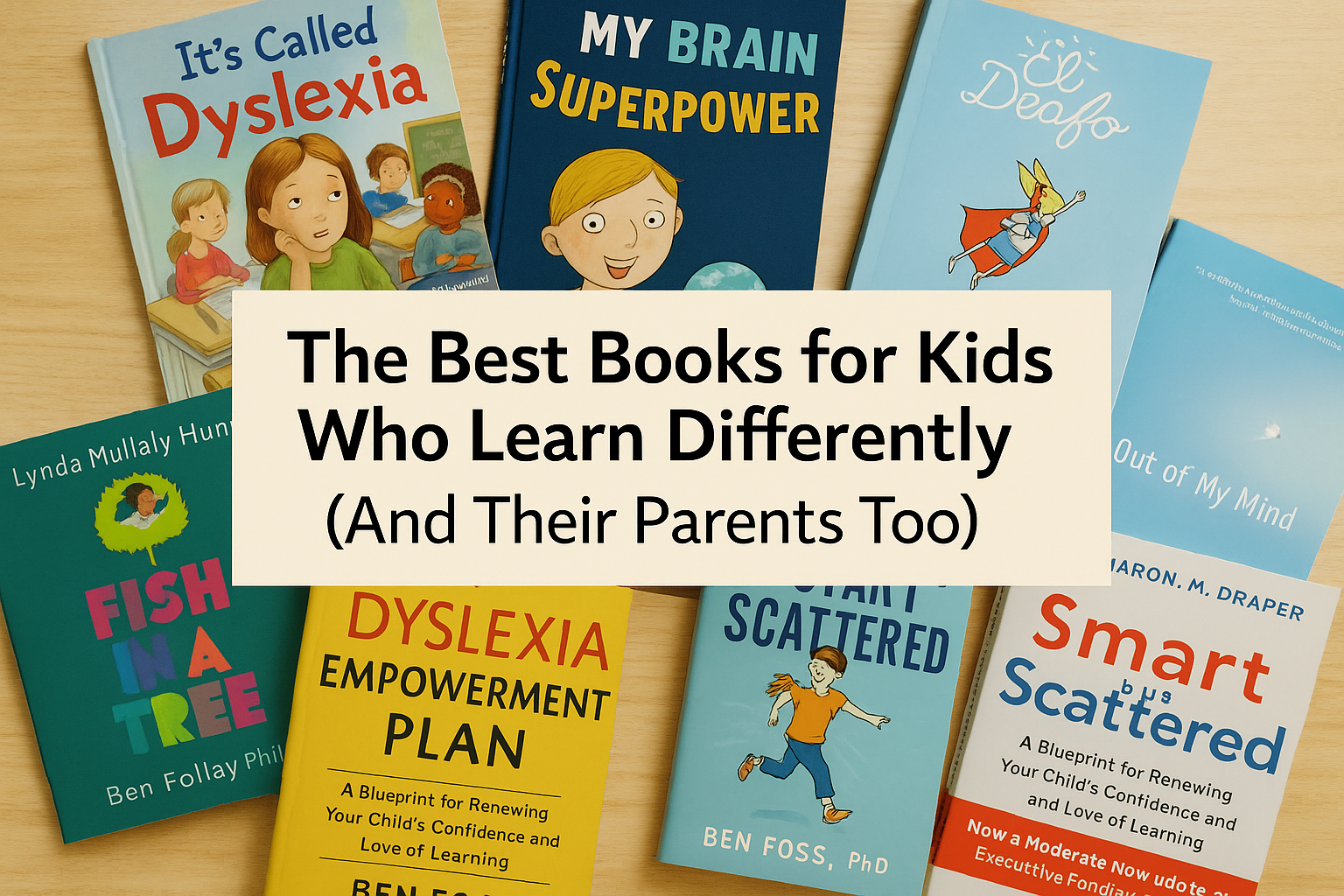
1. It’s Called Dyslexia by Jennifer Moore-Mallinos
A compassionate and easy-to-understand picture book that explains dyslexia from a child’s perspective. It helps young readers feel seen and reassured that they’re not alone.
2. The Alphabet War: A Story about Dyslexia by Diane Burton Robb
This story follows a young boy struggling with reading who learns to persevere. It shows that with the right support, students with dyslexia can thrive.
3. Mrs. Gorski, I Think I Have the Wiggle Fidgets by Barbara Esham
Part of the “Adventures of Everyday Geniuses” series, this book tackles ADHD in a humorous and relatable way for early elementary readers.
4. My Brain Is a Superpower by Alana Andrews
Written by a young author with dyslexia and ADHD, this book empowers children to see their differences as strengths.
For Tweens & Middle Schoolers (Ages 10–13)
5. Fish in a Tree by Lynda Mullaly Hunt
A moving novel about a girl who has hidden her dyslexia for years and finally begins to believe in herself when she gets the support she needs.
6. El Deafo by Cece Bell
A graphic novel memoir about growing up with hearing loss. Though not about a learning difference per se, it addresses themes of self-advocacy and inclusion that resonate with many neurodiverse readers.
7. Joey Pigza Swallowed the Key by Jack Gantos
This fast-paced, funny, and honest book gives readers a window into life with ADHD—without sugarcoating the challenges.
For Teens (Ages 14+)
8. Out of My Mind by Sharon M. Draper
Melody has cerebral palsy and cannot speak, but her intellect is sharp and her inner world is rich. This novel challenges assumptions and celebrates persistence.
9. The Power of Different: The Link Between Disorder and Genius by Gail Saltz, M.D.
Teens who want to understand how their brain works will appreciate this empowering look at how many “disorders” are tied to creativity and innovation.
10. This is Not the Abby Show by Debbie Reed Fischer
A funny and heartfelt story about a girl with ADHD who must learn to navigate friendships, school, and her own sense of self.
For Parents & Caregivers
11. The Dyslexia Empowerment Plan by Ben Foss
Written by a successful adult with dyslexia, this book offers a roadmap for parents to support and advocate for their children.
12. Late, Lost, and Unprepared by Joyce Cooper-Kahn and Laurie Dietzel
An excellent guide to understanding and supporting children with executive functioning challenges.
13. Smart but Scattered by Peg Dawson and Richard Guare
A favorite among parents and educators, this book offers clear, actionable strategies to help kids who struggle with focus, planning, and organization.
14. The Explosive Child by Dr. Ross W. Greene
Not just for children with learning differences, this classic helps parents manage inflexible or easily frustrated kids with empathy and skill.
15. Uniquely Human: A Different Way of Seeing Autism by Dr. Barry Prizant
An uplifting, compassionate book that applies broadly to how we understand and support all neurodiverse learners.
Final Thoughts
Books can be more than mirrors—they can be maps. They help children see themselves and offer families tools for the journey ahead. Whether you’re reading with your child or learning alongside them, these titles offer hope, humor, and understanding.
Private schools are often seen as desirable alternatives to public education—offering smaller class sizes, specialized programs, and enriched curricula. However, when it comes to serving students with learning differences such as dyslexia, ADHD, dysgraphia, and executive functioning challenges, many private schools are not equipped to meet those students’ needs effectively. This gap can leave families with few options and students without the necessary supports to thrive.
Lack of Legal Mandates
Unlike public schools, private schools are not bound by the Individuals with Disabilities Education Act (IDEA). This federal law requires public schools to provide a free and appropriate education to students with disabilities, including the development of Individualized Education Programs (IEPs) and access to specialized services. Most private schools are exempt from these requirements, which means that students with learning differences may not receive formal accommodations or legally protected support plans.
Limited Specialized Staff and Training
Many private schools do not have on-site learning specialists, special education teachers, or school psychologists trained in learning differences. While some schools may offer basic academic support or tutoring, they often lack the infrastructure and expertise to deliver targeted interventions like Orton-Gillingham instruction for dyslexia or executive functioning coaching for ADHD. Teachers may also receive limited professional development in recognizing and responding to diverse learning needs.
Curriculum Inflexibility
Because private schools are not required to adhere to state or federal special education standards, their curricula may not be designed with neurodiverse learners in mind. Students who need differentiated instruction, extra time on assignments, or alternative assessments may struggle in rigid academic environments that emphasize pace, performance, and conformity over personalized support.
Accessibility and Inclusion Gaps
Even in well-intentioned private schools, inclusivity efforts may fall short. Learning differences can be stigmatized or misunderstood, particularly in academically competitive settings where students are expected to meet uniform benchmarks. Without strong policies or inclusive practices, students with learning differences may experience isolation, low self-esteem, or academic failure.
Financial Barriers to External Support
Some private schools recommend that families seek outside support—such as private tutoring, therapists, or educational evaluations—to fill gaps in service. These services, while valuable, often come at a significant financial cost and can place an additional burden on families who are already paying high tuition fees.
Notable Exceptions
There are private schools that specialize in serving students with learning differences, such as those with full-time learning support teams, customized curricula, and expertise in special education. However, these schools are relatively few in number and often have long waitlists or high tuition, making them inaccessible to many families.
What Families Should Consider
Before enrolling a child with learning differences in a private school, families should ask:
-
What types of academic accommodations are available?
-
Are there certified learning specialists on staff?
-
How does the school support students with ADHD, dyslexia, or other challenges?
-
Is the school willing to collaborate with outside providers?
-
Are faculty trained in differentiated instruction?
Conclusion
Private schools can offer enriching academic experiences, but many are not structured to meet the needs of students with learning differences. As awareness grows, some are beginning to expand their support systems—but for now, parents must do thorough research and advocacy to ensure their child will receive the services and understanding they deserve.
-

For families raising children with learning differences, it’s important to understand that tutoring—while sometimes helpful—is not a substitute for the right school placement. Tutoring can be expensive, and it often cannot replicate the comprehensive services, accommodations, and specialized instruction that a school designed for students with learning differences can provide. In fact, many students enrolled in schools that specialize in supporting diverse learners do not need outside tutoring at all, because the school itself provides the interventions and strategies required for academic growth.
That said, when used appropriately, the right tutoring service can still be a powerful tool. It can build confidence, close academic gaps, and equip a child with tools for long-term success—not just in school, but in life. But with countless tutoring options available, how do you know which one is right for your child?
Here’s what you need to know, what questions to ask, and what red flags to avoid.
1. Start with Your Child’s Unique Learning Profile
Before you begin your search, take time to understand (or revisit) your child’s learning strengths and challenges. Review any existing documentation:
-
Neuropsychological evaluations
-
IEPs or 504 plans
-
Teacher reports or progress summaries
These documents can help clarify whether your child struggles with executive functioning, language processing, dyslexia, ADHD, or other challenges. A good tutor will want this information—and should know how to interpret it.
Pro Tip: Don’t work with a service that glosses over your child’s diagnosis or says it doesn’t matter. It matters.
2. Look for Specialized Expertise
Not all tutors are equipped to support students with learning differences. Ask potential providers:
-
Do your tutors have training in special education or learning disabilities?
-
Are they familiar with Orton-Gillingham, Wilson, or other structured literacy programs?
-
How do they tailor sessions for kids with ADHD or executive functioning challenges?
-
Will my child have the same tutor each session?
Ideally, you’re looking for someone who brings both subject-matter expertise and an understanding of how your child learns best.
3. Prioritize Relationship and Fit
Tutoring isn’t just academic—it’s relational. Students need to feel safe, understood, and encouraged. This is especially true for students who’ve experienced repeated frustration in school.
Ask:
-
Will we have an introductory session to see if the tutor and student connect?
-
How do you handle situations where a student is discouraged or resistant?
Watch how the tutor interacts with your child. You’re not just hiring a teacher—you’re bringing in a mentor and cheerleader.
4. Expect Goal Setting and Progress Tracking
A quality tutoring service should develop clear, measurable goals and communicate progress regularly. Vague reassurances like “things are going well” aren’t enough.
Ask:
-
What goals will we set in the first few sessions?
-
How do you track and communicate progress?
-
How do you coordinate with my child’s school or teachers?
Look for transparency. You deserve regular updates and clarity about what’s working—and what’s not.
5. Ask About Scheduling, Flexibility, and Cost
Logistics matter. Consider:
-
How many sessions per week are recommended?
-
Is there a consistent schedule or flexibility built in?
-
What’s the cancellation policy?
-
Are there options for in-person, virtual, or hybrid sessions?
-
What are the hourly rates, and do they vary based on the tutor’s experience?
Some services may offer packages or financial assistance—ask.
6. Red Flags to Watch Out For
-
Promises of rapid transformation (“Your child will be reading at grade level in 4 weeks!”)
-
No assessment process before starting
-
Lack of training in learning differences
-
High tutor turnover or inconsistency in staffing
-
Poor communication with families
Final Thought: Trust Your Instincts
You know your child better than anyone. If something feels off—push back or move on. The right tutoring relationship will feel collaborative, respectful, and hopeful.
What to Bring to a Consultation:
-
Neuropsychological or psychoeducational evaluations
-
IEP/504 documentation (if applicable)
-
Report cards or teacher notes
-
A list of specific concerns or goals
-
Your child, if possible, to observe rapport and interaction
Choosing the right tutor isn’t just about boosting grades—it’s about helping your child feel capable, confident, and empowered. With the right support, students with learning differences can thrive not in spite of their challenges, but because of their strengths.
-

President Donald Trump has begun taking concrete steps to dismantle the U.S. Department of Education, following through on a long-promised agenda to reduce federal involvement in public education. While framed by the administration as an effort to return control to states and local districts, this move poses serious and lasting risks to students with learning disabilities. For the millions of children who depend on federally mandated support and protections, the elimination of the Department of Education could erode essential services and widen existing educational disparities across the country.
Why the Department of Education Matters
The U.S. Department of Education is more than just a bureaucratic entity; it serves as a safeguard for millions of students, particularly those who are most vulnerable. It administers and enforces critical federal laws like the Individuals with Disabilities Education Act (IDEA) and Section 504 of the Rehabilitation Act, which mandate that public schools provide appropriate accommodations, services, and support for students with learning disabilities such as dyslexia, ADHD, dyscalculia, and dysgraphia.
These laws aren’t merely symbolic—they are enforceable mandates that ensure students with learning differences receive Individualized Education Programs (IEPs), access to special education professionals, and evidence-based interventions. Without federal oversight, there’s a real risk that these protections could become inconsistent, diluted, or entirely ignored at the state level.
The Threat of Fragmentation
Eliminating the Department of Education would effectively shift full responsibility for educational policy and funding to the states. While some states have strong frameworks for supporting students with learning differences, many do not. Without federal standards and monitoring, disparities between states would likely widen, and students’ rights could vary drastically depending on where they live.
This fragmentation would disproportionately harm students with learning disabilities, many of whom already face significant educational and societal barriers. Families in under-resourced districts—often already struggling to provide adequate support—would be left with little recourse or accountability if services were denied or mishandled.
Federal Funding at Risk
Beyond legal protections, the Department of Education provides essential federal funding for special education through IDEA grants. In fiscal year 2023 alone, the department distributed more than $14 billion to states for special education services. These funds help pay for specialized teachers, assistive technology, and professional development for educators working with students with learning differences.
If the Department were dissolved, it’s unclear whether or how this funding would be sustained. States would either have to absorb the cost—an unlikely scenario in many cases—or see services reduced or eliminated altogether.
A Step Backward for Educational Equity
In an era where inclusion and educational equity have become central goals in public education, dismantling the very agency charged with enforcing those values represents a dangerous step backward. Students with learning disabilities have fought—through their families and advocates—for decades to secure recognition, support, and legal protections. Removing the Department of Education threatens to unravel that progress.
While reforms and criticisms of federal education policy are fair and worth discussion, the complete elimination of the Department is not reform—it is abandonment. It ignores the real needs of millions of students and disregards the federal government’s responsibility to ensure equal access to education for all.
Final Thoughts
Students with learning differences already face steep challenges in our education system. Eliminating the U.S. Department of Education would make those challenges steeper and more isolating. Rather than cutting away support, policymakers should be working to strengthen it—ensuring that every child, regardless of how they learn, has the opportunity to thrive.
Dedicated to supporting families with children with learning differences.
© 2025 - 2026 • Learning Support Chicago • Questions? Email webmaster@learningsupportchicago.org
All Rights Reserved