Real-World Role Models Who Prove There’s No One Right Way to Learn
Learning differences can feel isolating—especially in school environments that value speed, conformity, and conventional achievement. But the truth is, many of the world’s most successful people struggled with reading, writing, attention, or organization. What made the difference? In most cases, it wasn’t overcoming their learning differences—it was learning how to work with them.
Below are stories of high-achieving artists, scientists, entrepreneurs, and leaders who have learning differences—and who’ve used their unique strengths to shape the world. These stories can build confidence and remind students (and families) that success doesn’t come from being “typical”—it comes from being authentic.
Whoopi Goldberg – Dyslexia
The Oscar-winning actress and co-host of The View was called “slow” and “lazy” throughout her childhood. She struggled in school and didn’t learn she had dyslexia until adulthood. What helped her succeed? Creativity, confidence, and mentorship.
“The advantage of dyslexia is that my brain puts information together in a different way. I see things that other people don’t.”
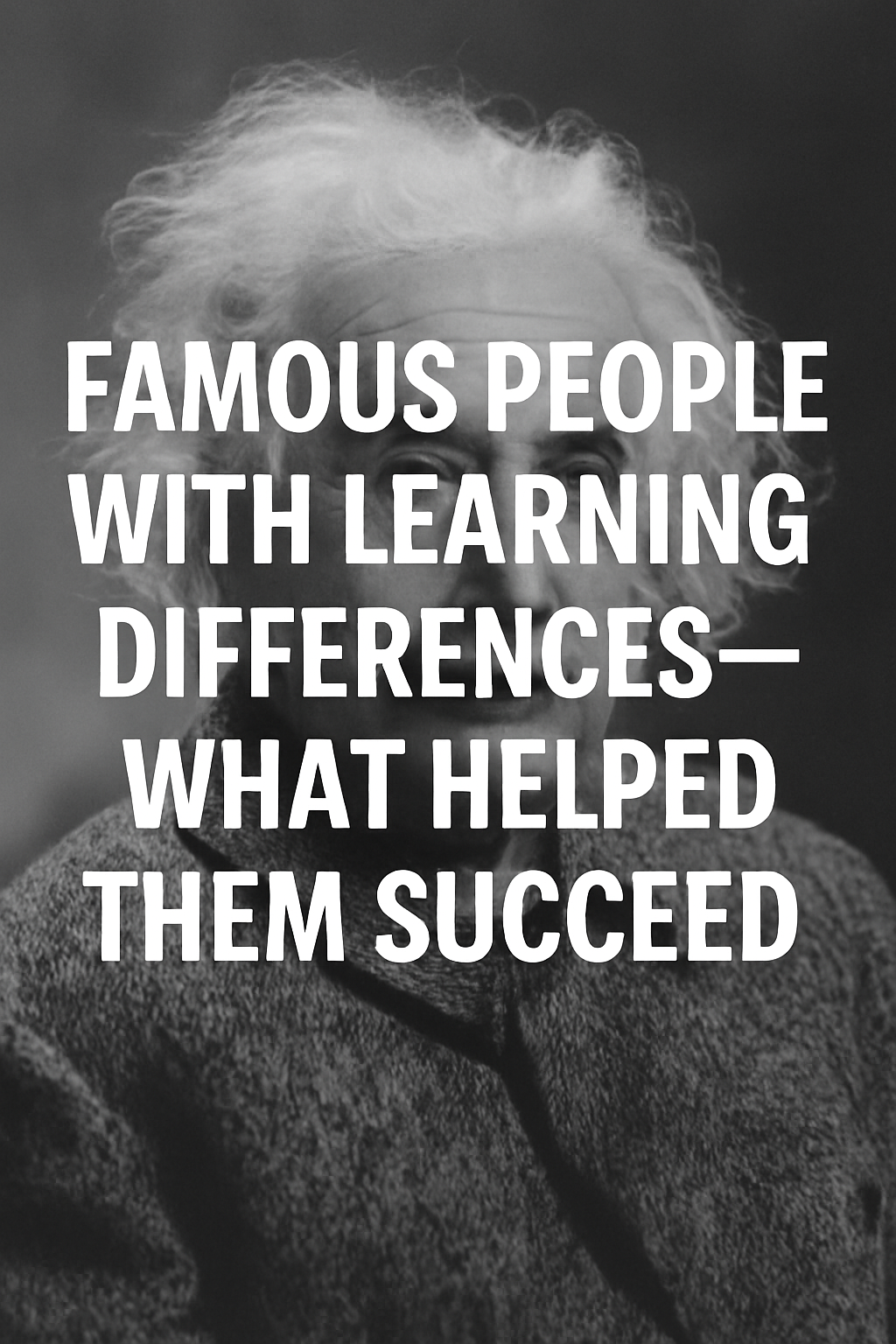
Albert Einstein – Likely Dyslexia & Language Processing Difficulties
Though never formally diagnosed, many historians believe Einstein had learning differences. He didn’t speak fluently until age four and struggled with traditional schooling. His success came from deep curiosity, an ability to visualize complex concepts, and time to explore ideas at his own pace.
“Everybody is a genius. But if you judge a fish by its ability to climb a tree, it will live its whole life believing it is stupid.”
Cher – Dyslexia and Dyscalculia
Cher openly talks about her learning struggles, including difficulty reading and doing math. She says she barely graduated high school. But through perseverance and finding passion in music and performance, she turned challenges into fuel.
“I had all these dreams, but I didn’t think they could happen because school made me feel like I wasn’t smart.”
Richard Branson – Dyslexia and ADHD
The founder of Virgin Group struggled in school and dropped out at 16. Branson has said dyslexia helped him think differently, take creative risks, and lead with empathy.
“Being dyslexic made me simplify everything, which has been a huge advantage in business.”
Agatha Christie – Dysgraphia
The queen of mystery novels dictated all her books due to a lifelong difficulty with writing by hand. Dysgraphia made handwriting difficult—but her storytelling skills were unmatched. She dictated over 60 novels and short stories.
Lesson: Success doesn’t require mastering every skill—just finding ways to express your talent.
Octavia Butler – Dyslexia
The groundbreaking science fiction writer struggled in school but was determined to be a writer from a young age. She credits her success to persistence, a vivid imagination, and the quiet strength of writing at her own pace.
“I just knew there were stories I wanted to tell.”
Common Threads: What Helped Them Succeed
While every story is different, these role models share key factors that helped them thrive:
-
Strength-Based Support: They focused on what they were good at, not what they lacked.
-
Mentorship & Encouragement: Someone believed in them—even when others didn’t.
-
Creative or Alternative Expression: Many used art, speech, movement, or technology to bypass areas of difficulty.
-
Persistence & Self-Belief: They didn’t give up, even when traditional systems failed them.
Final Thoughts
Learning differences don’t close doors—they open different ones. These famous figures prove that success isn’t about fitting into a mold; it’s about discovering your own shape. For students who struggle, their stories send a powerful message: Your brain is not broken. It’s brilliant.